When Sadness Lingers and Faith Feels in Question
November 19, 2026 • 4 min read
There is a particular weight in sadness that stays. The sadness itself may already be difficult enough, yet another question can slowly attach itself to the experience: If my faith were stronger, would I still feel this way?
Once that question appears, sorrow can begin to carry more than sorrow. It can become a measure you keep turning toward yourself, as though the continued presence of sadness might be saying something about the quality of your faith. What was already painful now stands beside a question about belief itself.
That question can be difficult to leave alone because faith and sadness may seem as though they should move in opposite directions. If faith means trust, hope, or nearness to God, lingering sorrow can appear to resist what faith is supposed to produce. The longer sadness remains, the easier it can become to wonder whether something spiritual should have changed by now.
Yet the relationship between faith and sorrow does not become clear merely because we want it to. Sadness can remain visible while faith is much harder to read, and the presence of one does not automatically explain the condition of the other. A feeling may be unmistakably present while its spiritual meaning remains uncertain.
That uncertainty matters. If lingering sadness is immediately interpreted as lack of faith, then the sadness is no longer allowed simply to exist; it is asked to testify about something larger than itself. It becomes evidence in a question it may not be able to answer.
And perhaps that is where the question becomes more delicate. How much can sadness actually tell you about faith? How much are you asking it to reveal?
There is a difference between recognizing that sorrow remains and deciding what its persistence means before God. The first is an acknowledgment of what is present. The second is an interpretation, and an interpretation can begin to feel certain long before the question underneath it has actually been settled.
Faith may then seem to be placed on trial by the duration of sorrow. Each day the sadness remains can appear to renew the same question, even if nothing new has been discovered about faith itself. Duration begins to feel like proof simply because it continues.
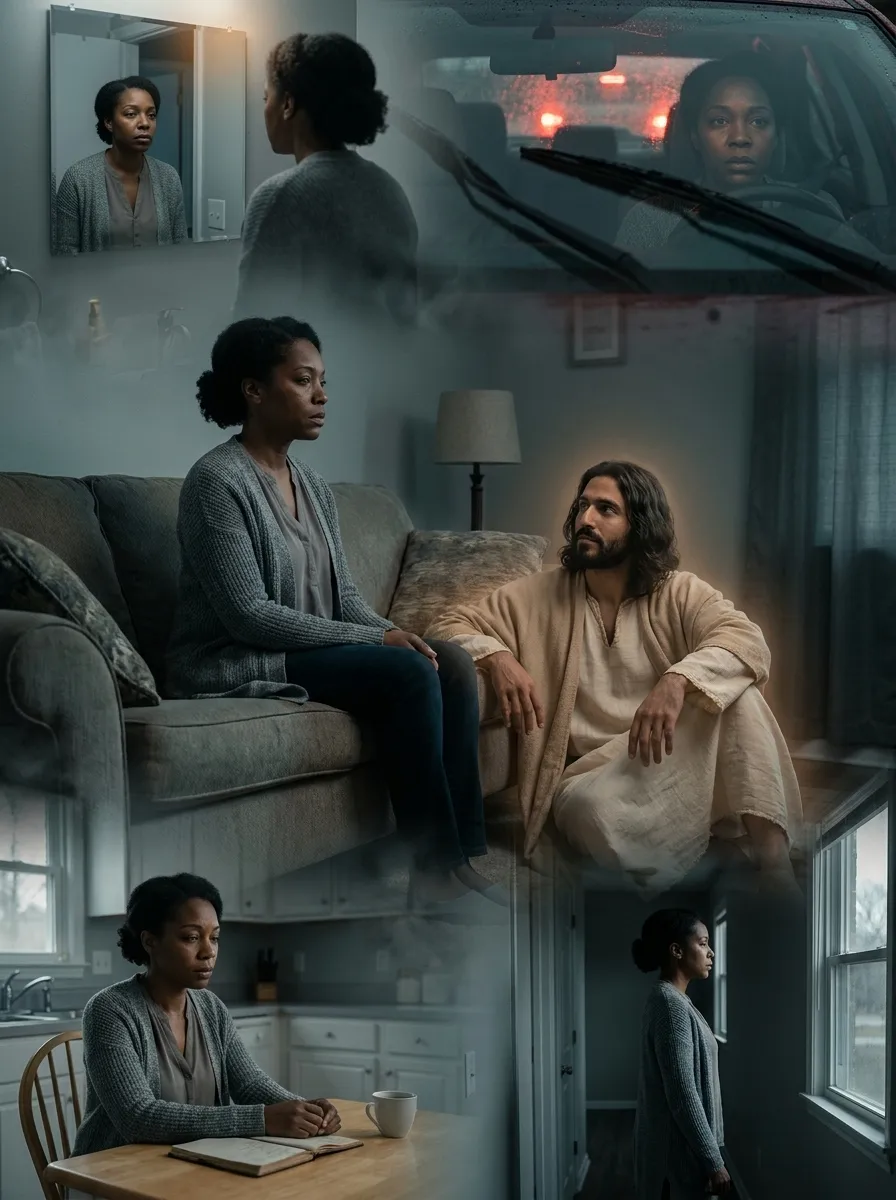
But the presence of Christ is not governed by the disappearance of suffering. One conviction offers a different frame: “The presence of Christ does not begin when suffering ends.” That sentence does not tell you exactly what your lingering sadness means, and it does not remove the question of faith. It changes the space in which the question is being asked.
If Christ’s presence does not wait for suffering to finish, then sorrow does not have to disappear before His nearness can be considered. His companionship and unresolved sadness are not required to take turns. The possibility remains that both may occupy the same unfinished place.
That does not make sadness spiritually insignificant. Neither does it give us permission to decide, from the existence of sadness alone, what faith is doing beneath it. The experience can remain real without becoming a complete explanation of your relationship with God.
Perhaps this is why the question can feel so difficult. You may want a visible sign that faith is strong enough, and the persistence of sadness can seem like the most obvious thing available to measure. Yet what is visible is not always capable of carrying the entire meaning we place upon it.
There is also something vulnerable about allowing the question to remain open. A quick conclusion would be easier in one sense: either the sadness proves something about faith, or it proves nothing at all. But an unfinished question asks for a different kind of honesty, one that can acknowledge sorrow without immediately turning it into a spiritual verdict.
Christ’s presence does not require that the uncertainty disappear first. He can remain near the question before you know how to answer it, just as His presence does not begin only after suffering has ended. The sadness may still be there, and the question about faith may still be there with it.
So perhaps the most faithful place to stand for now is not inside a conclusion. It may simply be inside the unresolved relation itself: sadness lingering, faith being questioned, Christ still present, and no forced meaning placed between them. What does lingering sadness actually reveal about faith?
The question can remain open.