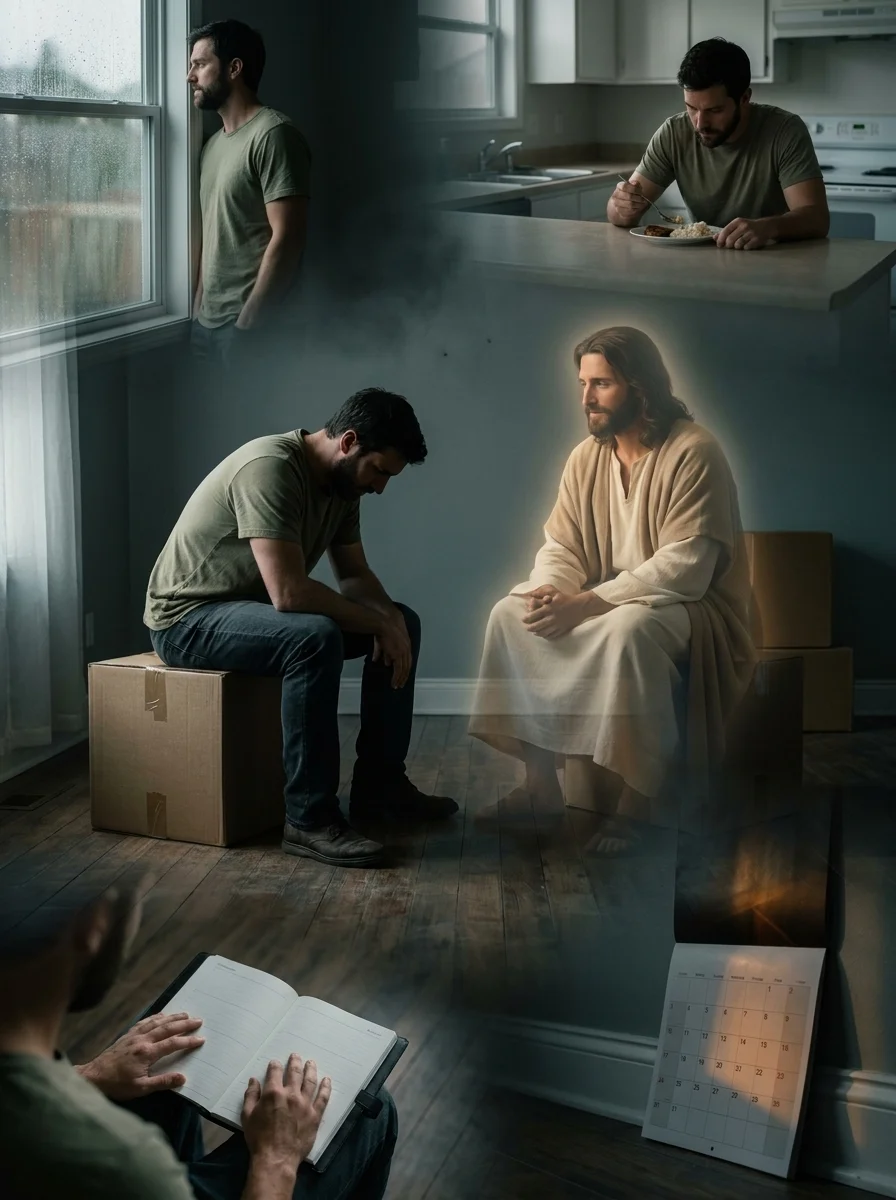
When Tomorrow Keeps Becoming the Place Where Life Is Supposed to Begin
November 3, 2026 • 5 min read
A better tomorrow carries an understandable attraction.
It can hold what the present does not seem to contain. More clarity. More room. More change. More of whatever would make life feel as though it had finally become what it was supposed to be.
There is nothing inherently wrong with wanting that tomorrow. The difficulty begins somewhere else.
It begins when tomorrow becomes more than a future possibility and starts becoming the place where significance itself has been located. The present remains real, but its meaning becomes conditional. Not yet.
Later. When something changes. When what is hoped for finally arrives.
That is what makes deciding to seek meaning in the present moment rather than constantly waiting for a better tomorrow more complicated than simply choosing optimism about today. The decision contains a tension.
Tomorrow may genuinely be different. It may contain something deeply desired. Refusing to build an entire life around that possibility does not require pretending that the possibility no longer matters.
The question is whether anticipation has been given authority over meaning. That is a different question. A future can be desired without becoming the only place where life is allowed to feel significant.
Yet the distinction is easy to blur because expectation gives tomorrow a particular brightness. What has not happened yet remains open. It has not been diminished by familiarity, interrupted by disappointment, or limited by the exact shape of what already exists.
The present has none of that distance. It is immediate.
It has already arrived with its actual conditions rather than imagined ones. There is no interval between what it promises and what it contains. Perhaps that is part of what makes the present harder to interpret.
Tomorrow can carry possibility. Today carries reality. And reality does not always look like the place where meaning was expected to be found.
Still, the fact that the present differs from what is hoped for does not determine what the present means. That difference deserves to remain visible.
There is no need to make today better than it is in order to ask whether it matters. Present meaning does not require declaring the current moment sufficient, ideal, beautiful, or secretly preferable to whatever might come later. That would turn the inquiry into another demand.
Meaning would simply be relocated from one forced conclusion to another. The present does not have to win a competition against tomorrow. Perhaps the more difficult possibility is that the two do not need to compete at all.
Tomorrow can still be wanted. Today can still remain incomplete. And the question of meaning can remain open inside the incompleteness.
That possibility becomes especially important when hope enters the conversation, because hope is easily associated with what has not happened yet. A future answer. A future change.
A future opening. A future condition different enough from the present to justify having waited for it. But if hope belongs entirely to that future, then the present becomes something else: an interval.
A passage. A place crossed on the way toward the life that will matter more.
The language is subtle because waiting itself does not necessarily carry that conclusion. It is possible to wait without declaring the present meaningless. The unresolved issue is what waiting has been asked to hold.
Has it become expectation? Or has it quietly become postponement of meaning? Those are not identical.
Expectation can face forward while remaining situated in the present. Postponement treats the present as though its value cannot yet be determined because the more important portion of life has not begun. That distinction does not answer what today means.
It simply keeps tomorrow from answering on today’s behalf.
“Because hope was never waiting for tomorrow.”
The sentence does not forbid hope for tomorrow. It does not deny that the future matters, nor does it require indifference toward what might change. It places pressure on a different assumption: that hope must remain suspended until the desired future becomes visible.
If hope is not waiting for tomorrow, then tomorrow cannot be the only location in which hope is permitted to exist. But even that leaves an open question. What would hope mean in the present if the present remains exactly as present as it is?
There is no need to provide a method. No practice has to be prescribed. No mental adjustment has to be offered as the correct way to become more attentive, more grateful, or more spiritually aware.
That would move beyond the question. The tension can remain nearer to the original decision. To seek meaning now is not necessarily to discover an answer about now.
Seeking is not the same as finding. That distinction protects the present from being forced to produce a spiritual conclusion simply because attention has finally turned toward it. The present moment may remain difficult to interpret.
It may seem ordinary. It may still be marked by incompleteness. It may still contain the very conditions that made tomorrow look more appealing in the first place.
Nothing about choosing to look at today requires those conditions to disappear. One possibility is that that is why the decision can feel so exposed. If meaning is reserved for a better future, the standard is clear: something needs to improve.
If meaning is allowed to remain an open question in the present, there may be no equally visible standard. Nothing necessarily proves itself. Nothing necessarily announces that this moment is significant.
And yet lack of proof is not the same as proof of absence. The present does not explain itself merely by being present. Neither does the future explain it merely by being preferred.
This creates a narrow but important space between longing and postponement. Longing can say, I still hope tomorrow will be different. Postponement says, Today cannot mean enough until it is.
The difference may be difficult to measure, but the two statements are not doing the same work. One keeps the future open. The other places a condition upon the present.
That condition deserves examination. How much of life must change before the life already being lived is allowed to carry meaning? There may be no immediate answer.
It may be that there should not be. Any quick resolution could make the present sound more spiritually legible than it actually feels. It could turn attention into certainty and uncertainty into a lesson.
The inquiry does not require that. Today can remain unresolved. Tomorrow can remain hoped for.
Neither has to be diminished in order for the relationship between them to become visible. And perhaps that relationship is the real question.
If a better tomorrow never needed to be abandoned, why did meaning have to be sent there ahead of us?