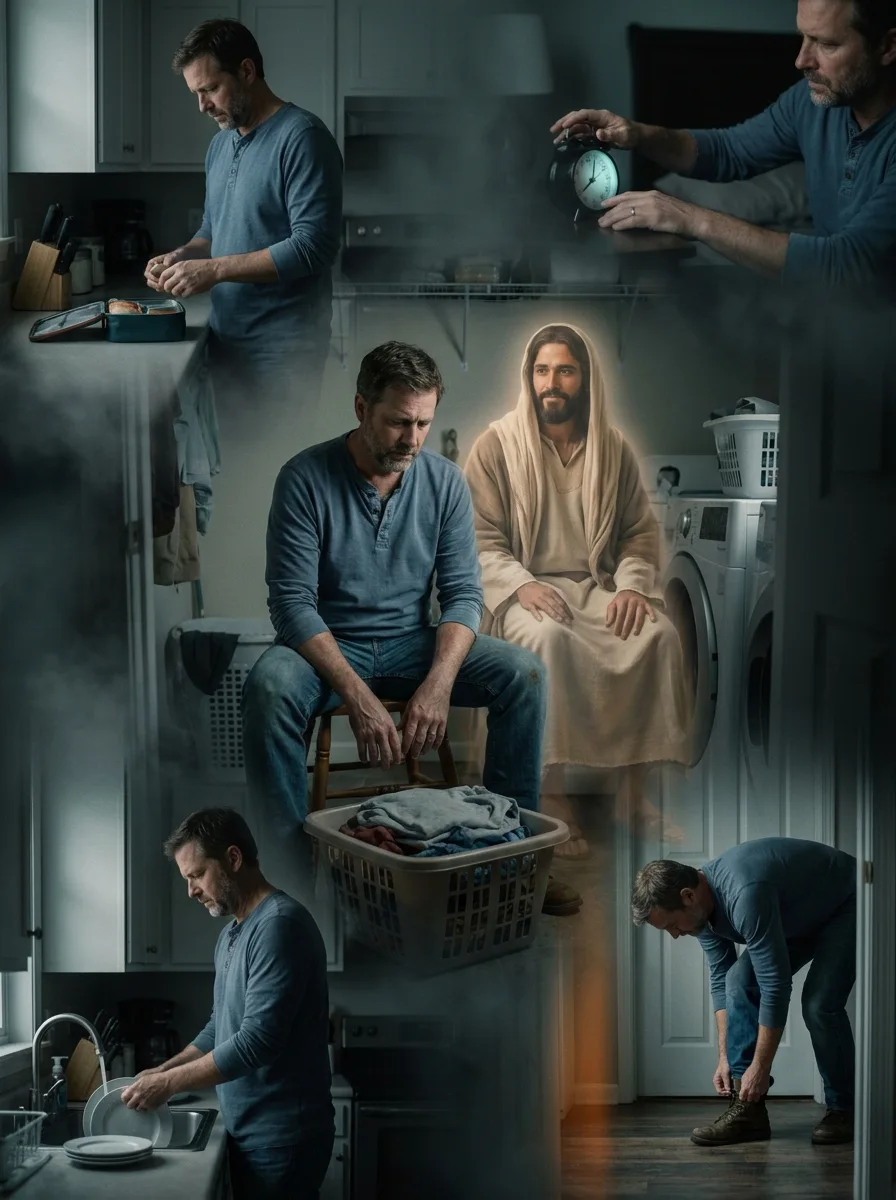
When Every Day Feels Like More of the Same
November 1, 2026 • 5 min read
There is a particular difficulty in repetition that has nothing to do with crisis. Nothing necessarily breaks, collapses, or dramatically changes. The same obligations simply return.
What was completed yesterday appears again today in another form. What required attention once requires attention again, and the satisfaction of finishing something can coexist with the knowledge that the larger rhythm has not finished at all.
This is part of what makes learning to endure the relentless repetition of daily chores and obligations without losing hope such a demanding inquiry. Repetition seems to ask for endurance without always providing a visible destination toward which that endurance is moving.
A beginning can carry anticipation. An ending can carry completion. Repetition often occupies the less defined space between them.
The work returns because life continues. Yet that simple observation does not explain what the repetition means. It does not determine whether an ordinary obligation is spiritually significant or spiritually empty, whether persistence inside it matters, or what hope is supposed to look like when the pattern remains unchanged.
Those questions cannot be settled merely by pointing toward the next task. Hope can easily be imagined as movement toward something different. Something changes, something opens, something finally arrives, and the present becomes bearable because it appears to be leading elsewhere.
But what happens to that understanding of hope when the immediate horizon contains more repetition? The obligation completed today may not disappear from tomorrow. The responsibilities that form ordinary life do not necessarily offer the kind of visible progression that makes meaning easy to recognize.
That does not make repetition meaningless. But neither does it automatically make repetition meaningful.
The distinction matters because there is a temptation to force spiritual importance onto the ordinary simply because the ordinary feels difficult to carry. Daily obligations do not need to be renamed profound in order to deserve serious attention. They can remain what they are.
Chores can remain chores. Obligations can remain obligations. Repetition does not need to become poetic before the question of God’s presence within ordinary life can remain open.
Perhaps part of the unresolved inquiry lies in the relationship between hope and novelty. If hope requires visible change, then repetition creates a difficult landscape for it. The recurring nature of ordinary responsibility offers very little novelty with which hope can prove that something is happening.
But perhaps the absence of novelty cannot, by itself, determine the absence of spiritual movement. That possibility does not require claiming that every repeated action contains a hidden lesson. It does not ask ordinary responsibility to become a coded message from God or suggest that repetition exists for some unprovided spiritual purpose.
It simply keeps one conclusion from becoming automatic. Nothing changed is not necessarily the same statement as nothing mattered.
The difference between those sentences is small enough to disappear in ordinary language. Yet one describes visible change, while the other assigns significance. Repetition makes that difference unusually difficult to ignore.
When something happens once, its uniqueness can give it importance. When something happens repeatedly, familiarity can remove the sense that anything noteworthy remains to be seen. But spiritual significance and novelty are not obviously identical categories.
That is where the ordinary life of Christ introduces a quiet complication: “Ordinary life was never an interruption to His ministry.” The sentence does not eliminate repetition. It does not declare every routine sacred merely because routine exists, and it does not turn obligation into spectacle.
It leaves ordinary life intact. Yet it refuses to treat the ordinary merely as the space between important things.
That distinction can remain beside the repetition without explaining it away. Christ’s presence within ordinary human life does not require the ordinary to stop being ordinary before it can be considered at all.
There is no promise inside that observation that daily responsibility will become easier. There is no claim that endurance will produce a particular outcome, or that repeated obligations are secretly leading toward some visible reward. The inquiry remains narrower.
What does hope depend upon when tomorrow may contain much of what today contained? If hope depends entirely upon interruption, then repetition can appear almost incompatible with it. Hope would always be waiting for the pattern to break before becoming fully possible.
But another question remains available. Must hope always be evidence that something different is coming, or can its meaning remain unresolved even while the same responsibilities continue? There is no need to answer that quickly.
A premature answer could make repetition sound more beautiful than it feels. It could transform endurance into achievement or turn ordinary responsibility into a spiritual test that must be passed correctly. Nothing in the repetition itself requires those conclusions.
The ordinary does not have to defend its existence. Perhaps what deserves attention instead is how easily significance becomes associated with departure from routine. The unusual becomes memorable because it interrupts; the repeated becomes almost invisible because it remains.
Visibility, however, is not the same thing as value. Nor does invisibility prove the opposite.
This leaves the daily pattern in an unusual position. It may not provide evidence dramatic enough to establish its meaning, yet it also cannot establish its own insignificance. The repetition remains.
So does the question of hope. There may be no need to manufacture a resolution between them. The obligations can continue to be repetitive without hope being reduced to the expectation that they will soon stop.
And hope can remain a question without being turned into a technique for enduring them. One possibility is that that is the tension worth preserving.
The day can contain work that has been done before and will need to be done again. Nothing about that repetition necessarily announces what God is doing within it. But nothing about it announces that He is absent either.
Between those two claims is a space that ordinary life does not automatically resolve. The question may not be how to make repetition feel meaningful enough to endure. The unresolved inquiry may be simpler and harder:
If hope seems easiest to recognize when life is changing, what does it mean to keep the question of hope open when ordinary life simply continues?