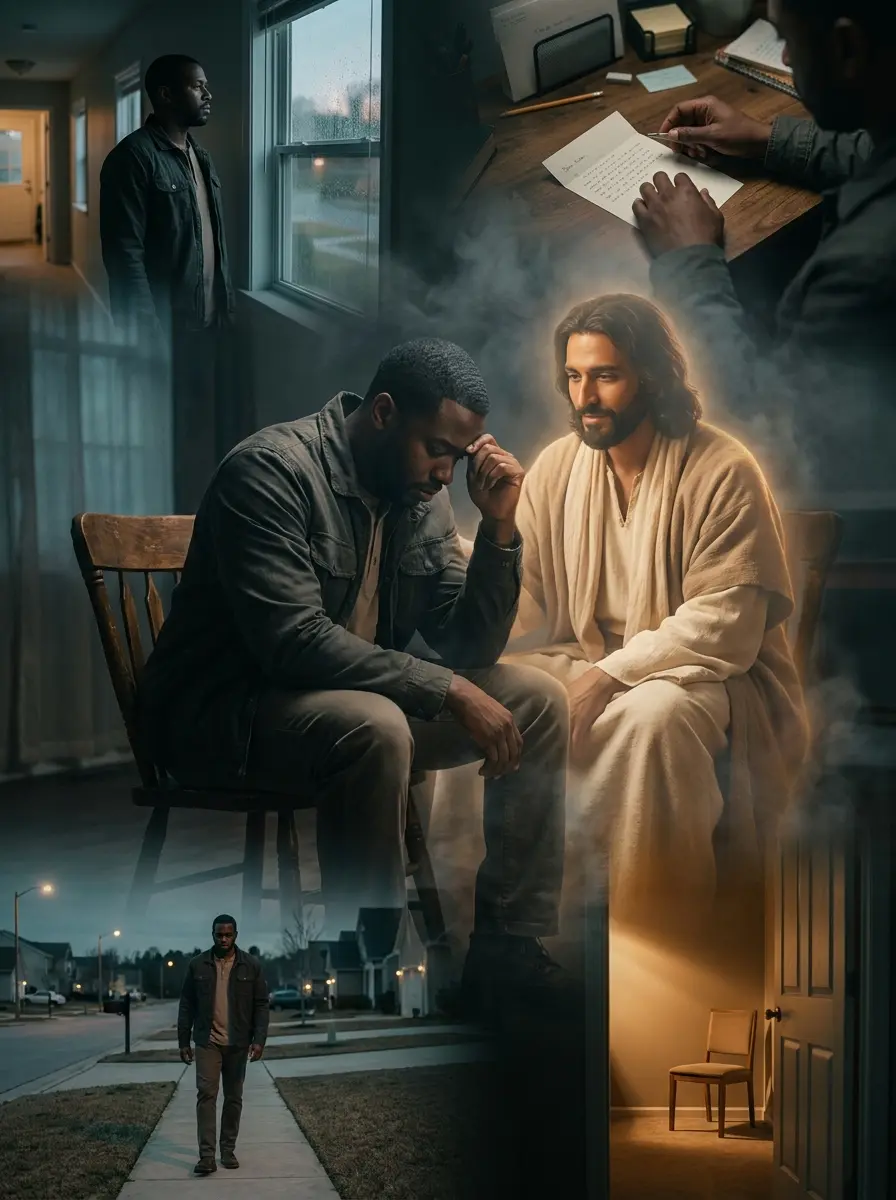
When You’re Afraid God Will Be Disappointed by the Truth
September 17, 2026 • 7 min read
There is a particular kind of fear that can appear around honesty with God. It is not necessarily the fear that He does not know.
It is the fear of what His knowing might mean once you stop holding something back. That distinction matters.
You may already believe that God knows what you think, what you question, what you regret, what you cannot explain, and what you would rather not say aloud. Nothing about honesty would give Him new information.
And yet saying something plainly can still feel very different from knowing that it is already known. There is knowledge.
Then there is disclosure. There is believing God sees.
Then there is allowing yourself to speak from the place where you are seen. Those movements do not always feel identical.
The difficulty can become sharper when honesty seems capable of producing disappointment. If I say what I actually think, will it sound faithless?
If I admit what I really feel, will it reveal something unacceptable? If I stop using the language I believe I should use and say what is actually present, what will God think of me?
The questions do not have to be dramatic to carry weight. Sometimes the feared truth is not rebellion or rejection.
It may simply be uncertainty. Confusion.
Anger you do not know what to do with. A prayer you no longer know how to pray sincerely.
An answer you wish you believed more firmly. A feeling that does not match the words you think faith is supposed to produce.
None of those possibilities has to be interpreted here. Their meaning remains open.
But the fear surrounding them can still be examined. What happens when honesty feels spiritually risky?
You may begin to notice that there are two conversations taking place at once. One concerns what is actually true inside you.
The other concerns what you believe should be true inside you. Between those two conversations, disappointment becomes imaginable.
Perhaps God expects more certainty. More gratitude.
More trust. More patience.
More willingness. More clarity.
And if what you actually bring does not resemble what you think He expects, honesty can begin to feel like presenting evidence against yourself. The truth is no longer simply the truth.
It becomes something that might lower you in His eyes. That possibility can make even prayer feel strangely complicated.
Because prayer is supposed to be a place where you speak to God. But what happens when the safest version of that conversation seems to require editing yourself first?
You can still speak. You can still use sincere words.
But some words may feel easier than others. Some questions may remain carefully outside the sentence.
Some emotions may be translated into forms that feel more acceptable. Some uncertainty may be softened before it is allowed to appear.
Not necessarily because you intend to deceive. No hidden reason has to be assigned to that restraint.
It can only remain with the tension itself. You believe honesty matters.
You also fear what complete honesty might reveal. Those two realities can sit beside each other without resolving quickly.
Perhaps that is why the idea of divine disappointment carries such unusual weight. Human disappointment is familiar enough as a concept.
Someone expects something from you. You do not meet the expectation.
Something changes in the space between you. When that relational pattern is imagined in connection with God, the stakes can feel much larger.
Now the question is not merely whether you have fallen short of an expectation. The question becomes whether being fully honest might alter the way you are received.
That possibility can make honesty feel less like openness and more like exposure. And exposure is different from information.
If God already knows, nothing new is technically being revealed. But something new may be happening in you when you stop arranging the truth before bringing it to Him.
You are no longer speaking only from what feels acceptable. You are allowing what remains difficult to stand in the same conversation.
That can feel dangerous precisely because it removes some control. You cannot decide in advance how the truth will sound once it is spoken plainly.
You cannot guarantee that it will sound mature. Or faithful.
Or grateful. Or resolved.
Honesty does not always arrive polished. Sometimes it is unfinished.
Sometimes contradictory. Sometimes it contains a question you expected to have answered years ago.
Sometimes it contains two things that do not seem to belong together. I trust You.
I am afraid. I believe.
I do not understand. I want to pray.
I do not know what to say. I love You.
I am angry. The existence of tension inside those statements does not resolve what any particular statement means.
It simply keeps the interior reality from being flattened into something cleaner than it actually is. And perhaps the fear of disappointment becomes strongest precisely there.
Not when honesty is elegant. When it is messy.
When the sentence does not finish where you hoped. When you cannot immediately add the reassuring qualification.
When the truth has no spiritual conclusion attached to it. Questions do not offend God.
That sentence does not answer every question you might be afraid to ask. It does not tell you that every conclusion is correct.
It does not remove the seriousness of what you believe. It does not declare that honesty makes every thought harmless.
It simply refuses to make the existence of a question itself into an offense. That is a smaller claim than complete reassurance.
And perhaps a more demanding one. Because if questions themselves do not offend God, then the fear of disappointing Him cannot be settled merely by hiding them.
The question remains. The fear remains.
And now the relation between them becomes harder to ignore. What exactly seems capable of disappointing God?
The content of what you are thinking? The fact that you are thinking it?
The lack of certainty? The honesty?
The possibility that the truth about your inner life does not match what you imagine faithfulness should look like? Those are not interchangeable questions.
They may lead in different directions. But they can easily become compressed into a single feeling:
I cannot let God see me like this. Even when you believe He already does.
That contradiction is difficult to solve because it may not really be about visibility. It may be about reception.
Being seen is one thing. Being received while seen is another.
And perhaps that is the deeper uncertainty inside the fear of divine disappointment. Not whether God knows.
Whether His knowing changes His nearness. That question can remain open without being turned into a lesson.
There is no need to force an answer through reassurance. No need to tell yourself that you should suddenly become comfortable with complete honesty.
No need to make vulnerability into another spiritual achievement. Even honesty can become performance if it is treated as something you must now do correctly.
You must tell God everything. You must be completely open.
You must feel safe. You must trust without hesitation.
You must no longer fear disappointment. That would simply create another set of expectations around the same unresolved place.
Perhaps the inquiry can remain quieter. What happens if honesty is allowed to be honesty before it becomes proof of anything?
Before it proves courage. Before it proves trust.
Before it produces closeness. Before it changes how you feel.
What if the difficult sentence is allowed to exist without being required to accomplish something? That possibility leaves much unresolved.
The truth may still feel uncomfortable. The question may remain unanswered.
The fear of disappointment may still be present. And you may still wonder what complete honesty would mean in a relationship with a God who already knows what you have not yet said.
Nothing here settles that tension. It only prevents the fear from disappearing behind more acceptable language.
You believe God knows. You are still afraid of disappointing Him. Between those two realities remains a difficult question:
If nothing you say can surprise God, what exactly do you fear will change when you finally tell Him the truth?