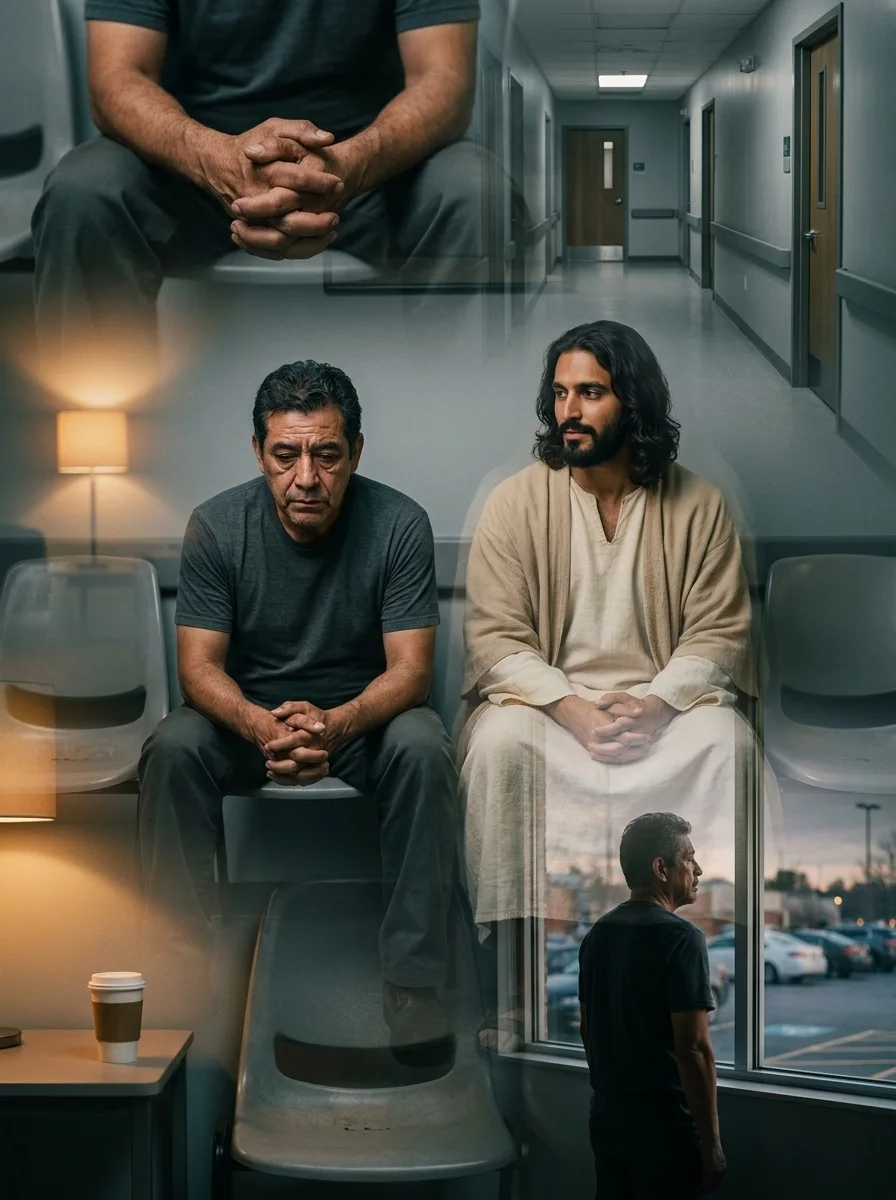
When the Waiting Room Has Nothing to Tell You
October 15, 2026 • 5 min read
A waiting room can be full and still feel lonely. The loneliness does not necessarily come from being physically alone. It can come from inhabiting a question that no one in the room can answer.
No news has arrived. That absence creates its own kind of space. There is nothing new to understand, nothing definite to respond to, nothing that allows the waiting to become something else.
So the moment remains suspended.
You are not yet receiving good news. You are not yet receiving bad news. You are simply still there, somewhere before knowing.
That position can feel strangely isolating.
Conversation may still be possible. Other people may still be nearby. Yet there is a part of waiting that cannot be shared merely because someone else occupies the same room.
The question is still yours to carry. And until news arrives, there may be very little anyone can place beside it.
Waiting rooms seem to emphasize this peculiar condition because they are spaces built around what has not happened yet. Their meaning depends upon an arrival that remains outside the room: an update, an answer, a name being called, some movement from uncertainty toward information. Until then, the room offers almost nothing.
It does not explain the delay. It does not tell you what the silence means. It does not indicate whether the next words will change everything or leave much unchanged.
It simply continues to be a place of waiting. Perhaps that is where the loneliness becomes so specific.
Ordinary loneliness can be imagined as separation from another person. This loneliness may arise while people are close enough to see, hear, or touch and still cannot cross the distance between uncertainty and knowledge for one another. Someone can sit beside you and still be unable to enter the unanswered part.
They cannot know on your behalf. They cannot receive the news early for you. They cannot make the next moment arrive simply because the present one has become difficult to inhabit.
There is a helpless boundary around that. Even love may have to remain outside it.
Not because love is absent, but because some uncertainty cannot be transferred. Another person may stay near without being able to carry the exact place inside you where the waiting has collected. And perhaps that is why silence can feel larger in a waiting room.
There is already so little to do with what is unknown. Every unanswered minute leaves the central fact untouched: there is still no news. Eventually, even language may seem unable to alter that.
What can be said that changes the condition of not knowing? Reassurance does not become information. Hope does not become information.
Fear does not become information. Prayer does not become information. All of them may exist, but the unanswered question remains separate from them.
This can make the waiting feel almost sealed. You may still speak to God there. You may also have very little to say.
The loneliness of that room does not necessarily disappear because prayer is possible. Nor does prayer need to pretend that loneliness has disappeared in order to remain prayer.
“He is present in waiting rooms.”
It is a small sentence to place beside such an unresolved space. It does not tell the room what will happen next. It does not shorten the distance between now and whatever news may come.
It does not tell you how to interpret the delay. It does not convert uncertainty into confidence. It simply refuses to make a waiting room one of the places from which Christ must be absent.
That is a different kind of statement. Presence is not the same as information. Companionship is not the same as explanation.
And neither one necessarily changes the fact that the person who is waiting may still feel intensely alone. Those realities can remain beside each other without becoming easy to reconcile. Christ may be present.
The room may still feel lonely. No news may still have arrived. The next moment may still be completely unknown.
Nothing requires one of those statements to erase the others. Perhaps the difficulty is that presence is easiest to recognize when it produces something visible. A changed circumstance gives the mind something to hold.
But a waiting room before the news contains no such resolution. If Christ is present there, His presence cannot depend upon the answer already having arrived. It would have to belong to the unfinished part.
To the minutes that do not yet know what they are leading toward. To the unanswered question before it can be interpreted through hindsight. To the room while it is still only a room.
That possibility may be difficult to recognize precisely because nothing about it solves the waiting. The loneliness may remain untouched enough to be felt fully. There may still be the sense that no one can quite reach the place where uncertainty has gathered.
And perhaps that raises a harder question about companionship itself. Must companionship remove loneliness in order to be real? If someone remains beside you while being unable to answer what you most need answered, has their presence failed?
If Christ does not provide the news, explain the silence, or disclose what comes next, what kind of companionship can be recognized before any of those things occur? There is no need to force an answer. The waiting room has already asked enough from the present moment.
It may be enough to notice the question without turning it into another demand. Because the loneliness here is not imaginary simply because someone may be near. And nearness is not necessarily meaningless simply because loneliness remains.
Both may occupy the same chair. Both may exist beneath the same silence. Both may endure while the door stays closed and no new information enters the room.
The waiting itself does not decide between them. It leaves the question exactly where the person waiting has been left:
What does companionship mean in a place where no one, not even the silence, has told you what happens next?