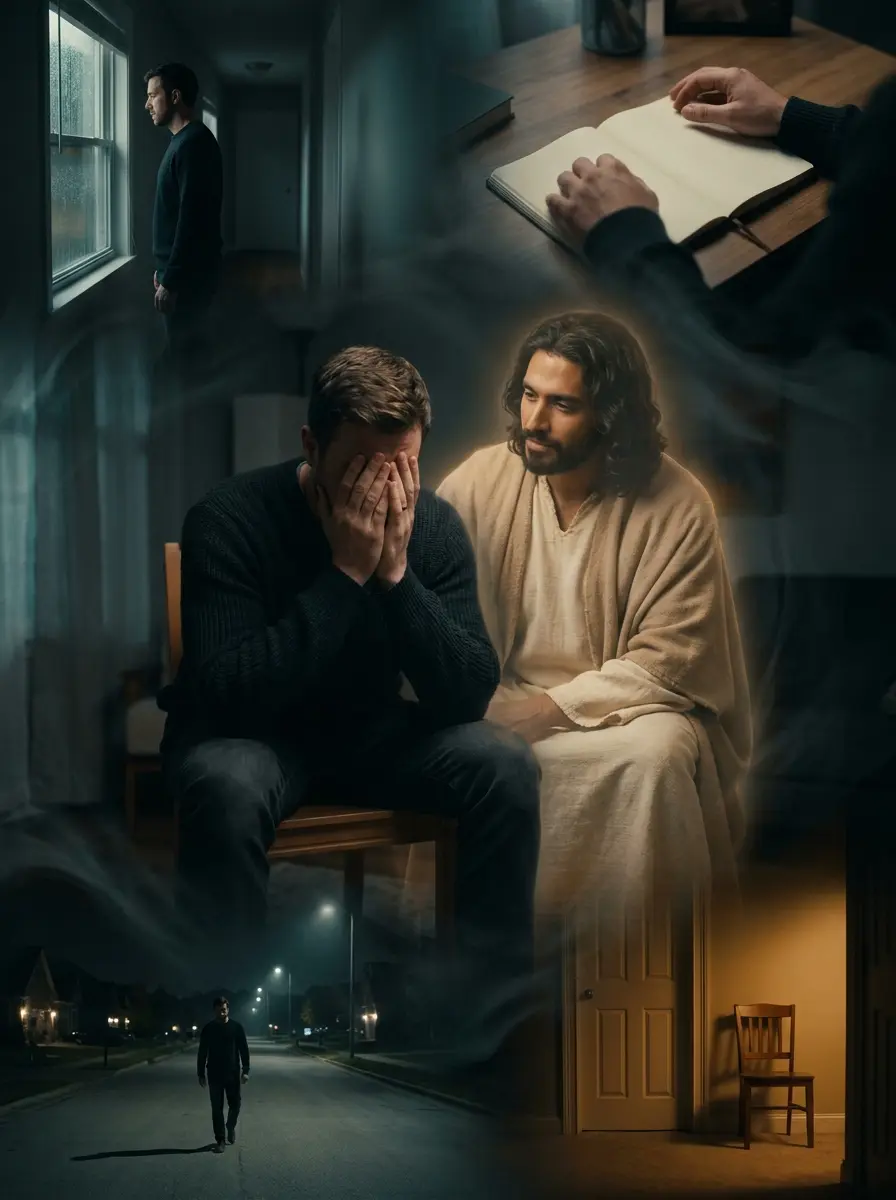
When Grace Feels Hardest to Accept Right After You Fail Again
September 24, 2026 • 7 min read
There is a particular difficulty in receiving grace after a repeated mistake. Not simply after doing something wrong.
After doing something wrong again. The repetition changes the way the moment can feel.
A first failure may leave room for surprise. A repeated one can seem to arrive with history attached.
You recognize it. You know you have been here before.
And whatever you hoped would be different this time is now standing beside the fact that it was not. The mistake may be finished.
But the word again remains. That one word can carry enormous weight.
Again. The same weakness.
The same failure. The same awareness that what you intended and what you actually did have separated once more.
Nothing more needs to be added to make the moment difficult. And yet grace enters precisely there.
Not after sufficient distance has been created. Not after the memory has softened.
Not after improvement has made mercy easier to accept. Immediately.
That timing can feel almost uncomfortable. Because correction makes intuitive sense after failure.
Regret makes intuitive sense. Responsibility makes intuitive sense.
Grace can feel harder. Perhaps because grace seems as though it should arrive later.
After you have demonstrated that the mistake mattered. After you have thought about it long enough.
After you have become serious enough. After you have begun changing.
Then perhaps grace would feel appropriate. But grace arriving before any of that creates a difficult question.
What exactly are you supposed to do with kindness when you have not yet become different? The mistake is still recent.
Nothing has been repaired merely because you regret it. No evidence of lasting change has appeared.
The distance between what happened and what should have happened remains fully visible. And grace does not wait for that distance to disappear before becoming relevant.
That can feel almost too easy. Not necessarily because grace is easy.
Because receiving something you did not first improve enough to deserve can challenge the order you expect things to happen in. Failure.
Then correction. Then change.
Then acceptance. That sequence feels understandable.
Grace interrupts it. Because grace always walked through the door before correction ever did.
Before. That word changes the entire shape of the encounter.
It does not erase correction. It does not make the mistake insignificant.
It does not turn repetition into something harmless. It simply places grace somewhere you may not naturally place it.
At the beginning. Before evidence.
Before improvement. Before the moment has become easier to look at.
There can be resistance in that. If you accept grace too quickly, does that mean you are taking the mistake lightly?
If you stop condemning yourself immediately, have you failed to understand the seriousness of what happened? If mercy is already available, what keeps responsibility from becoming shallow?
Those questions deserve room. They should not be silenced with reassurance.
Because accepting grace is not necessarily the same thing as deciding that nothing matters. Grace and indifference are not identical.
Neither are mercy and denial. A mistake can remain a mistake while grace remains grace.
That sounds simple until the mistake is fresh. When failure is recent, harshness can feel more appropriate than mercy.
There can be something almost morally satisfying about refusing comfort. At least then the weight of the moment feels acknowledged.
At least then the disappointment has somewhere to go. At least then the repetition has a consequence inside you.
No fixed meaning needs to be assigned to self-condemnation in any particular person. The tension already present can remain where it is.
Grace is being considered immediately after repeated failure. And immediately may be exactly what makes it difficult.
Later is easier to imagine. Later, perhaps you will have changed.
Later, perhaps the mistake will not feel so close. Later, perhaps you can look back and say that something meaningful came from it.
Grace received then may feel connected to progress. Grace received now has no such support.
Now there is only the mistake and the fact that it has happened before. Nothing has yet had time to become a lesson.
Nothing has become a testimony. Nothing has been transformed into evidence that this time will be different.
Grace has nothing visible to lean on. Perhaps that is precisely what makes it grace.
Not the reward for becoming someone else. Not the acknowledgment that you finally learned enough.
Not the warmth waiting at the end of successful correction. Something that appears while the problem is still honestly a problem.
That order can be difficult because it removes one way of controlling the relationship. If grace comes only after improvement, then improvement becomes a kind of entrance fee.
Change enough. Prove enough.
Stay consistent long enough. Then come closer.
But grace before correction does not allow you to purchase your way back through better behavior. That does not remove the importance of change.
It simply refuses to make change the price of being met. There is a strange vulnerability in that.
Punishment can feel easier to understand. Achievement can feel easier to understand.
Even distance can feel easier to understand. Grace asks you to remain visible before you have anything impressive to bring.
And repeated failure leaves very little impressive to bring. You cannot point to novelty.
You cannot say you did not know. You cannot use the fact that this has never happened before.
The word again stands in the room. And grace does too.
Neither cancels the other. Perhaps this is where the tension becomes clearest.
The mistake tells the truth about what happened. Grace tells a different kind of truth about what happens before correction has finished its work.
The two can coexist without being blended together. You do not have to call the failure good in order to receive grace.
You do not have to call grace earned in order to take the failure seriously. You do not have to decide that mercy means nothing needs to change.
You also do not have to decide that change must happen before mercy is allowed near. Those distinctions matter because repeated mistakes can create an almost irresistible desire for proof.
Proof that you mean your regret. Proof that you finally understand.
Proof that you will not return here. Proof that grace will not be wasted on you.
But in the immediate aftermath, that proof may not exist. You have intentions.
Perhaps you have remorse. Perhaps you have questions.
But the future is still the future. You cannot use tomorrow’s faithfulness as evidence today.
So grace has to be considered without guarantees. That may be one of the hardest things about receiving it.
You cannot promise enough to make it safe. You cannot know with certainty that this failure will never repeat.
You cannot transform the present moment into a completed story. The mistake is real.
The pattern has repeated. The outcome remains unknown.
And still, the question of grace is already present. What does accepting it mean here?
Does it mean feeling forgiven? Feeling relieved?
Feeling close to God? Does it require an emotion at all?
Does acceptance have to feel like something? That question can remain open.
Grace does not need to be turned into another emotional performance. You do not have to manufacture peace to prove that you received it.
You do not have to feel suddenly restored. You do not have to move quickly from regret into reassurance.
The moment may remain uncomfortable. You may still dislike what happened.
You may still wish the repetition did not exist. You may still be unable to imagine what meaningful change will look like.
Grace does not automatically remove any of that. Perhaps accepting grace in this moment is difficult precisely because nothing else has been resolved.
The mistake is still a mistake. The repetition is still repetition.
Correction has not become completion. The future has not supplied evidence.
There is only the possibility that grace does not need to wait for all of those things. That possibility can feel undeserved.
Of course it can. If grace required deserving, the question would be entirely different.
But something else remains unresolved. Can mercy be received without being used as an excuse?
Can responsibility remain intact without self-rejection becoming necessary? Can correction begin in the presence of grace rather than as the condition for finally obtaining it?
Those questions do not need to be answered quickly. Perhaps they should not be.
Repeated mistakes rarely become easier merely because a beautiful sentence is placed beside them. And grace should not be used to make reality prettier than it is.
The failure happened again. That is still true.
Grace came before correction. That is still true too.
The difficulty may lie in allowing both truths to occupy the same moment. Without reducing the mistake.
Without postponing grace. Without demanding that either one erase the other. Maybe this is where the question remains:
If grace does not wait until you have finally proven that you will never fail this way again, can you receive it while the word again is still painfully present?