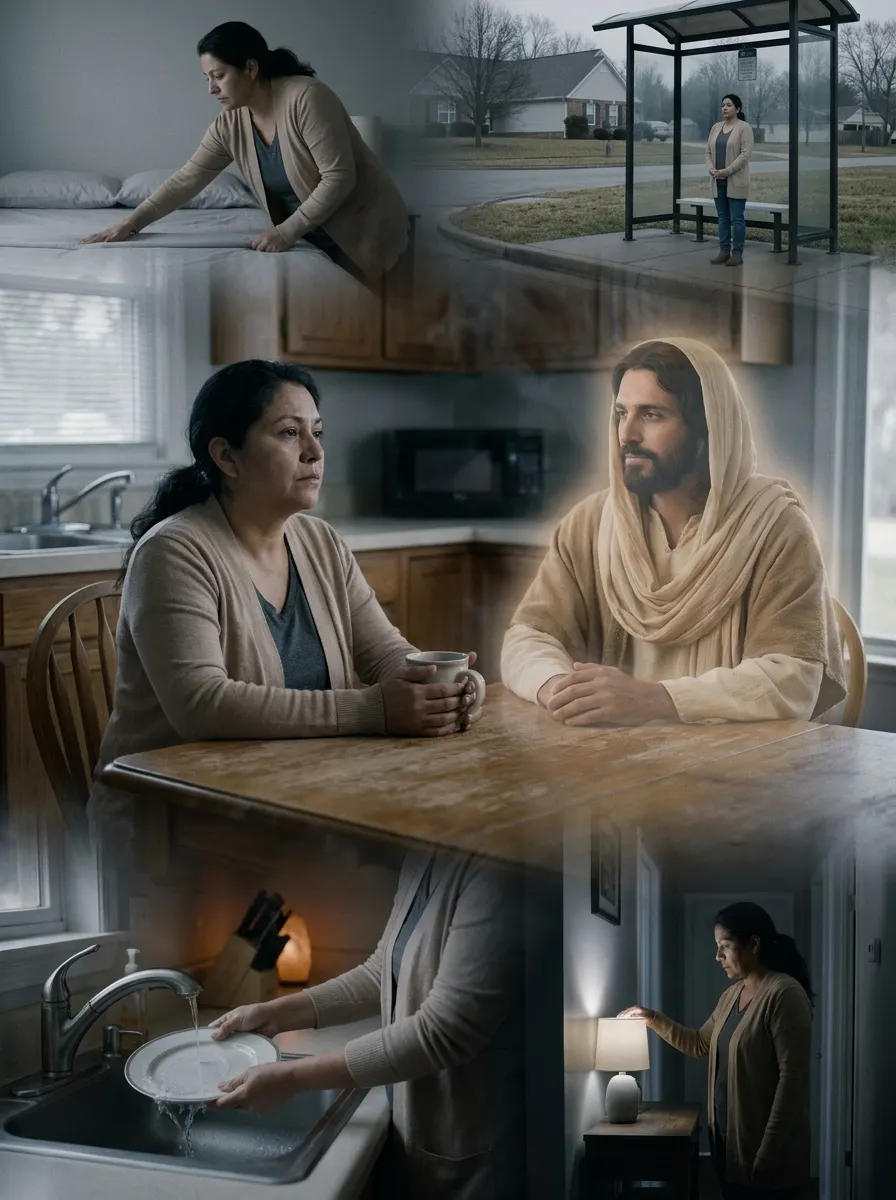
When an Uneventful Life Starts to Feel Spiritually Insignificant
October 25, 2026 • 4 min read
There is a difference between saying that life has been uneventful and saying that life has been spiritually insignificant. The first describes what seems to have happened. The second interprets what that apparent lack of happening means.
Those two judgments can become so closely connected that they begin to sound like one statement. Nothing remarkable happened, therefore nothing spiritually significant happened. But the word therefore is doing more work than it first appears.
An uneventful life does not announce its own meaning. It does not explain what its quietness signifies, what should be concluded from its lack of visible turning points, or whether anything beyond the immediately noticeable should be recognized within it.
The interpretation arrives afterward. Somehow, uneventfulness becomes evidence. That is where the question becomes difficult.
What exactly would make a life spiritually significant? Would significance have to become visible through events substantial enough to be noticed, remembered, or named?
If so, spiritual importance would become closely tied to eventfulness. The remarkable would carry weight precisely because it could be recognized as remarkable, while what does not rise above the ordinary would remain harder to interpret.
Perhaps that distinction feels almost natural. Significant things should look significant. And yet even that sentence contains an assumption worth leaving open.
There is no obvious measurement by which an outwardly uneventful life can be assigned a spiritual value. The absence of conspicuous events can be observed; spiritual insignificance cannot be observed in quite the same way. It has to be inferred.
That small difference matters because an inference can begin to feel like a fact simply through repetition. Nothing much happened can gradually become indistinguishable from nothing much mattered. The two statements are not identical.
One speaks about event. The other speaks about meaning. Once they are separated, another question appears: what has been carrying the authority to define significance in the first place?
Perhaps the question is not whether an uneventful life should suddenly be described as extraordinary. That would simply reverse the language while leaving the same standard untouched. It would still make significance depend upon finding some hidden form of extraordinariness.
The unresolved possibility is quieter than that. The word uneventful may need no rescue, nor does an ordinary stretch of existence have to be renamed, embellished, or made secretly dramatic before its spiritual meaning can remain an open question.
That possibility does not answer the question. It changes what is being asked. Instead of asking how an uneventful life might prove its significance, it becomes possible to wonder why significance was required to prove itself through eventfulness at all.
That distinction leaves something unsettled.
If nothing especially remarkable has happened, there may be little available to point toward as evidence. No visible milestone necessarily appears to settle the matter. No dramatic contrast has to divide life into an obvious before and after.
The interpretation therefore remains exposed. Uneventful may still be accurate. Spiritually insignificant is something different.
To join them requires a conclusion about what spiritual significance is supposed to look like. And perhaps that conclusion deserves examination precisely because it can remain almost invisible. It can hide inside familiar expectations about what should count, what should feel meaningful, and what should be recognizable enough to deserve spiritual attention.
There is room to gently challenge that conclusion. Not by replacing it with another certainty. Not by insisting that every quiet moment must contain some hidden message that needs to be uncovered.
That would answer too much. The deeper difficulty is that spiritual insignificance can begin to seem self-evident when very little appears to be happening. Yet the apparent lack of events still cannot, by itself, explain what that lack means.
It leaves interpretation unfinished. One possibility is that this is where the word ordinary becomes especially demanding. It offers very little spectacle with which to construct a verdict.
Nothing about it automatically announces importance. Nothing about it automatically announces unimportance either. The silence between those two possibilities may be uncomfortable because it refuses to provide an immediate measure.
There may be no need to fill that silence. An uneventful life can remain uneventful without being forced into a larger claim. The visible description can remain intact while the spiritual interpretation stays unresolved.
That does not transform ordinary life into something else. It simply refuses to make one conclusion inevitable. And so the question remains where it began, but perhaps more clearly now.
When life appears uneventful, what exactly makes spiritual insignificance seem like the necessary meaning of that uneventfulness? There may be no need to settle that question here. It may be enough to notice that it is still a question.